01
Connect your repository
GitHub or GitLab. CRAcheck reads your manifests (package.json, requirements.txt, go.mod…) — nothing to install.
octocat/payments-api Connected
Reading manifests…
package.jsongo.modrequirements.txt

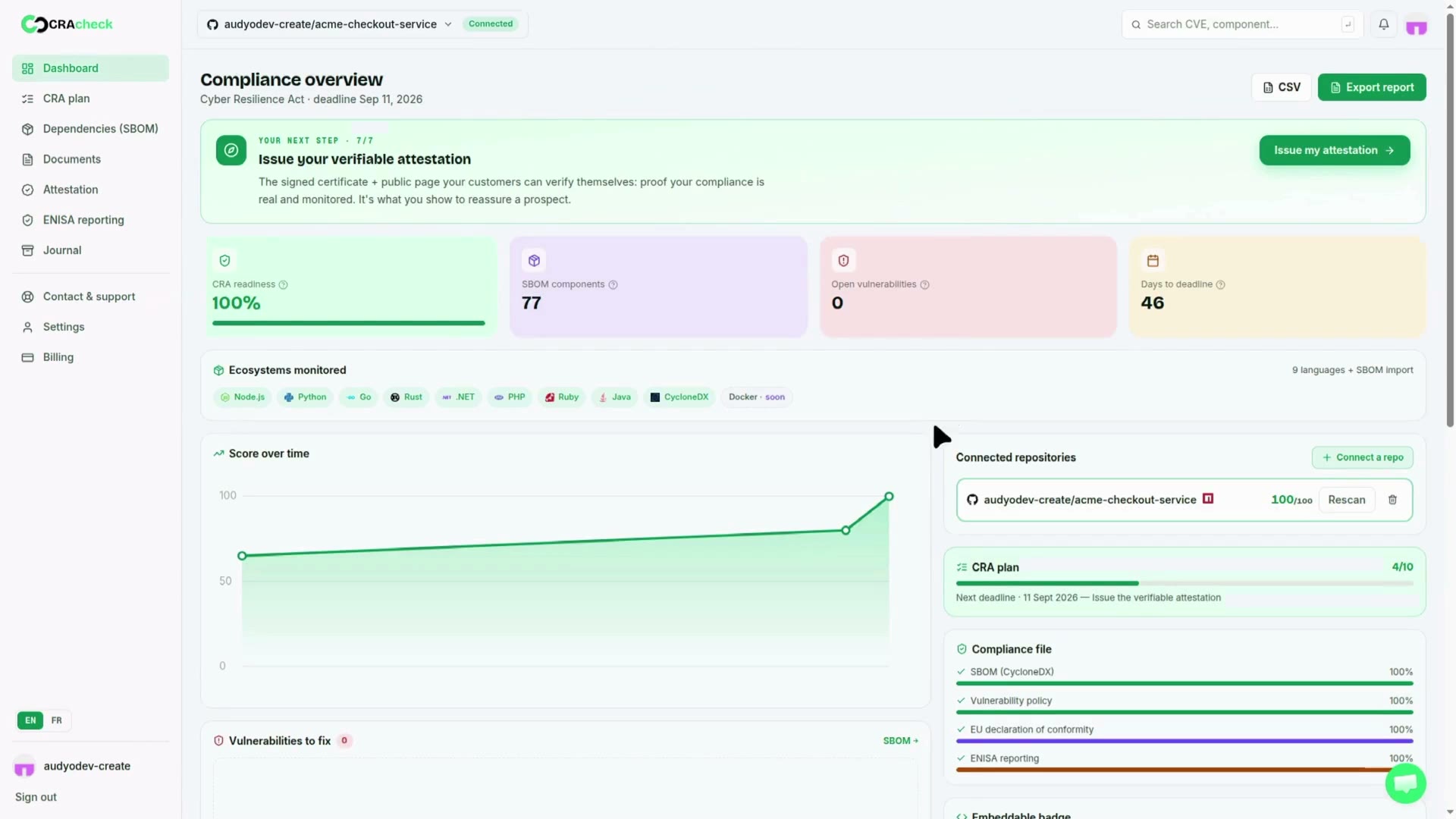
SBOM, technical documentation and EU declaration — generated and maintained automatically from your repo. CRAcheck prepares and documents your compliance; you review and sign. Without reading 200 pages of regulation.
No credit card · −50% for life for early sign-ups
The EU regulation that sets cybersecurity rules for almost every digital product. We explain the essentials in 2 minutes.
Understand the CRA →The regulation is 200 pages long. You ship code. CRAcheck turns your repository into a complete compliance file — in minutes.
Join early access →GitHub or GitLab. CRAcheck reads your manifests (package.json, requirements.txt, go.mod…) — nothing to install.
Your full software bill of materials in CycloneDX or SPDX format, kept up to date on every build.
The technical file (CRA Annex) and your EU declaration of conformity, pre-filled and ready to sign.
Your vulnerability handling policy, plus the ENISA reporting templates (24h / 72h / 14 days).
/ Step 0 · free
Ten questions at most, no sign-up, to find out whether the Cyber Resilience Act applies to your product, which class it falls into and what you must produce. Every question tells you which point of the regulation it checks.
Nothing is sent anywhere: the test runs in your browser.
Already know you're in scope? The audit settles it product by product.
Scope, risk categories and obligations taken from Regulation (EU) 2024/2847 — no guesswork, no AI making things up. Every verdict is grounded in the regulation.
Read the regulationSolo devs, app makers, IoT, commercial open source. Enterprise tools ignore you or charge €500/month. CRAcheck is built for you, at your scale.
See pricingWe prepare and document. We don't pretend to “certify you compliant”: you stay in control, with no false promise or legal jargon.
How it worksOnce your repo is connected, CRAcheck works continuously — even when you don't log in.
You don't have to think about it: we email you the moment something important happens for your compliance. Zero noise, just the essentials.
A board listing everything you must do, in order, with the real deadlines. No more guessing where to start.
A signed certificate + a public page your customers check themselves. Your compliance becomes a selling point.
EU declaration, technical documentation, SECURITY.md — generated from your repo and profile. You review, you sign.
The day a flaw is exploited, the assistant pre-fills your 24h / 72h / 14d reports. No panic.
The CRA score shows on your pull requests like a test that passes or fails. Compliance enters your workflow.
Every scan and document is timestamped in a journal. It's what a regulator or B2B customer will ask for.
€0 — but days of work
€500+ / month
€25 / month
* Doing it yourself is free in money, but costs days of work and a real risk of error.
 Open source vulnerability database/ Vulnerability detection
OSV.dev is the reference open source vulnerability database, fed by Google, GitHub Security Advisories, PyPA, RustSec… On every push, your SBOM is cross-checked against it: a new CVE on one of your dependencies means a recalculated score + an email alert. No black-box scanner — a public, auditable source, cited in your technical documentation.
We tell you honestly what isn't there yet. The product improves every week — and your launch price stays locked for life.
Connect your GitLab projects, in addition to GitHub.
Your CRA score shown in every pull request, like a test that passes or fails.
Scan your Docker images and containers too, not just repositories.
Check your compliance locally and in your CI, straight from the command line.
Automatic scheduled generation and export of your SBOM.
Get your vulnerability and deadline alerts straight into Slack.
 Shipped
Ask questions and chat directly with our team through live chat.
On September 11, 2026, vulnerability reporting becomes mandatory. The first 100 customers keep €25/month for life. After that, the price is €50/month.
To get your score and start.
Your compliance documented, monitored and attested continuously — ready to show your customers.
Secure payment via Stripe · no commitment · cancel in one click
CRAcheck is a self-assessment support tool. It is not a certification, not a notified-body assessment and not legal advice: compliance remains the manufacturer's responsibility.
Your customers and prospects verify your attestation themselves on cracheck.eu/verify — signed certificate, README badge, real-time status.
A CRA consultant charges €3,000–5,000 for a report that's outdated the day it's delivered. CRAcheck keeps your compliance alive all year — for the price of one lunch a month.
Not writing the code yourself?
The subscription above is for teams who write their own software. If you manufacture a connected product and don't yet know whether the regulation applies to you, that's an analysis job — and I do it for you.
Free diagnostic, full audit from €890.
Generally no: cloud-only SaaS falls under the NIS2 directive, not the CRA. The exception: if it ships a component installed on the customer side (agent, plugin, firmware) that's required to operate. The test settles your specific case.
Open source developed outside of a commercial activity is exempt. As soon as a company commercializes it or integrates it into a product it sells, that company carries the CRA responsibility.
No. CRAcheck provides information based on the official text to guide and prepare you. For formal validation, consult a professional.
Vulnerability reporting obligations apply from September 11, 2026. The main obligations (CE marking, EU declaration of conformity) from December 11, 2027.
Up to €15M or 2.5% of worldwide annual turnover for a breach of the essential cybersecurity requirements.
Yes: unlimited, no sign-up, and it runs in your browser. Only the document generator is paid (€25/month).

Master the mandatory 24-hour ENISA notification process under the Cyber Resilience Act. Ensure compliance for your software products before the 2026 deadline.

A strategic roadmap for startup founders and CTOs to navigate EU Cyber Resilience Act compliance requirements ahead of the 2026 and 2027 enforcement deadlines.
Overwhelmed by SBOM requirements? Learn how to generate, manage, and maintain a Software Bill of Materials to ensure supply chain security and compliance.

Master the EU Cyber Resilience Act as a solo developer. Follow this practical, step-by-step roadmap to achieve compliance without hiring expensive consultants.

Understand the severe financial penalties, operational risks, and market exclusion consequences of failing to comply with the EU Cyber Resilience Act.

Avoid common pitfalls with the EU Cyber Resilience Act. Learn how to manage SBOMs, meet ENISA reporting deadlines, and automate your compliance workflow.
A strategic action plan for software vendors to meet the mandatory EU Cyber Resilience Act incident reporting requirements by September 2026.
On September 11, 2026, reporting becomes mandatory. The €25/month launch price runs until the end of 2026, then €50. Go Pro now and keep €25/month for life.
Stripe payment · no commitment · cancel in one click